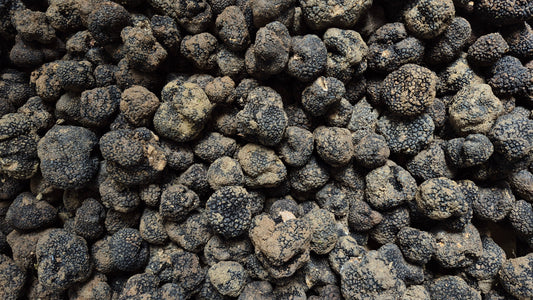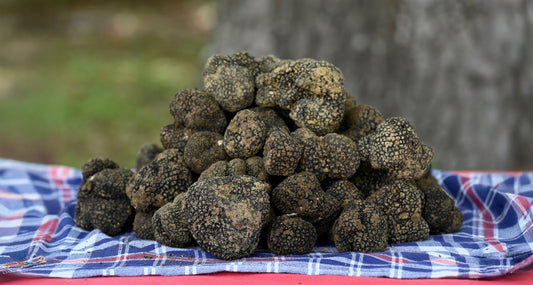

Anyone who has had the pleasure of tasting it knows: truffles have an unmistakable, intense, penetrating aroma, capable of dominating a dish with just a few shavings. But where does this peculiar aroma come from? And why is it irresistible for some and almost excessive for others?
The answer lies in the complex and fascinating chemistry of the truffle itself. Let's explore it together.
A Symphony of Volatile Molecules
The truffle's characteristic smell comes from a sophisticated mixture of volatile organic compounds. These are light molecules that are easily released into the air and interact with human olfactory receptors.
Each truffle species has its own "aromatic signature," composed of dozens of these molecules. Some evoke earthy notes, others recall garlic, honey, cheese, or undergrowth. But there is a group of compounds that plays a decisive role in defining the truffle's olfactory identity...
The Role of Sulfur Compounds
Sulfur-containing compounds – particularly dimethyl sulfide (DMS) – are among the main culprits for the truffle's pungent aroma. It is precisely these sulfur compounds that give that intense and slightly "wild" note that makes truffles so recognizable, even from a distance.
Curiously, the human sense of smell is particularly sensitive to sulfur-containing molecules, even in minimal concentrations. This is why the scent of truffles strikes immediately... and sometimes divides opinion: some love it madly, while others find it too intrusive.
The Soil Makes the Difference
The truffle's aroma doesn't just depend on its species. The soil in which it grows and the microorganisms present also play an essential role in forming the aromatic bouquet.
Fungi of the genus Tuber establish complex relationships with bacteria and other organisms in the soil. These microbes "collaborate" in the production of volatile compounds, modifying and enriching the truffle's olfactory profile.
In other words, every truffle carries with it a unique "environmental signature" that reflects its habitat of origin.
A Scent That Speaks the Language of Nature
The scent of truffle is therefore the result of a perfect synergy between biology, chemistry, and environment. A silent signal that tells the underground story of the fungus: where it was born, with whom it lived, and what makes it unique.
Next time you slice one over a warm dish, take a moment to really smell it. It's not just aroma: it's science, nature, and wonder, encapsulated in a fragrance.
Do you want to discover what a freshly harvested truffle smells like?
💡 Discover fresh truffles